How to Choose the Right Positive Displacement Blower for Your Industrial Application

How Do I Choose the Right Positive Displacement Blower for My Application? 

Choosing a positive displacement blower isn’t simply a matter of finding one that can produce enough air. The right blower needs to match the airflow, pressure or vacuum, operating schedule, environment, and installation requirements of your specific process. 

An undersized blower may struggle to meet demand, while the wrong blower technology can lead to unnecessary energy use, noise, maintenance, or performance issues. 

Lewis Systems offers several Gardner Denver positive displacement blower and vacuum technologies designed for different industrial applications and operating requirements.  

Start With Your Airflow and Pressure Requirements 

One of the first questions to answer is how much airflow your process requires and at what pressure or vacuum level. 

A blower used for wastewater aeration may have very different requirements than one used for pneumatic conveying or an industrial vacuum application. Choosing equipment based on the actual demands of the process helps ensure the blower can provide the performance you need without unnecessarily oversizing the system. 

Before selecting a blower, consider: 

  • Required airflow  
  • Required pressure or vacuum  
  • Normal and peak demand  
  • Changes in process demand  
  • Operating conditions  

These requirements provide a starting point for determining which blower technology and size may be appropriate. 

How Often Will the Blower Run? 

Duty cycle matters because a blower that operates occasionally has different requirements than equipment expected to run continuously. 

For continuous-duty applications, reliability and energy efficiency can become especially important. Even relatively small differences in efficiency can affect operating costs when equipment runs for long periods. 

Lewis Systems offers blower technologies designed for demanding continuous-duty applications as well as systems suited to other operating requirements.  

Do Noise and Pulsation Matter for Your Application? 

Noise isn’t just a comfort consideration. Depending on where the blower is installed, sound and pulsation can affect operators, surrounding work areas, and sensitive downstream equipment. 

Different positive displacement blower designs can address these concerns in different ways. 

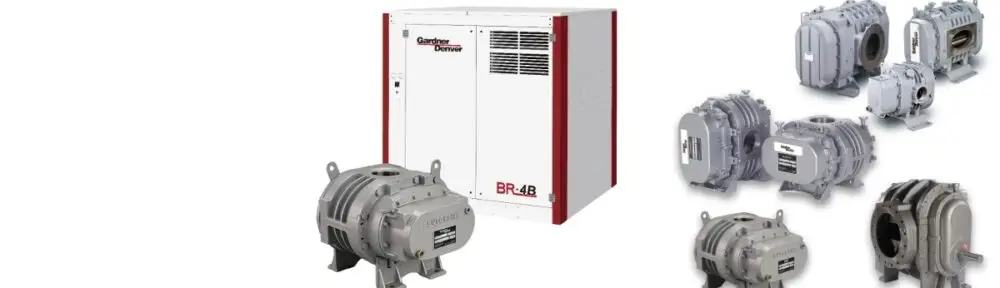
For example, Gardner Denver HeliFlow blowers use a helical tri-lobe design engineered to reduce pulsation and noise. TriFlow vacuum pumps also use a three-lobe design to provide lower noise, vibration, and pulsation compared with traditional two-lobe vacuum products.  

If noise or pulsation is already a problem with your existing equipment, it should be part of the conversation when selecting a replacement. 

Which Positive Displacement Blower Design Is Right for You? 

There isn’t one positive displacement blower design that’s best for every application. 

Lewis Systems offers several Gardner Denver technologies, including: 

  • CycloBlower for applications where energy efficiency, continuous operation, higher pressure or vacuum capability, and reduced pulsation are priorities  
  • HeliFlow for applications where lower noise, reduced pulsation, and reliability are important  
  • TriFlow for industrial vacuum applications requiring lower noise, vibration, and pulsation with flexible installation  
  • DuroFlow for applications that prioritize durability, dependable performance, oil-free air, and mounting flexibility  
  • Sutorbilt for demanding continuous-duty applications with multiple configuration options  
  • IQ blower packages for facilities looking for an integrated package with controls, monitoring, noise reduction, and simplified installation  

The right choice comes down to what your process actually requires rather than simply choosing the blower with the highest airflow or pressure rating. 

What Applications Use Positive Displacement Blowers? 

Positive displacement blowers are used across a wide range of industrial processes. Lewis Systems supports applications including: 

  • Wastewater treatment  
  • Pneumatic conveying  
  • Dry bulk handling  
  • Chemical processing  
  • Industrial vacuum systems  
  • Power generation  
  • Food and dairy processing  
  • Environmental remediation  

Because the operating conditions can vary significantly between these applications, equipment should be selected around the specific process rather than the industry alone. 

Find the Right Blower for Your Application 

Choosing the right positive displacement blower starts with understanding what your process needs today and how the equipment will operate over time. 

Lewis Systems can evaluate your airflow, pressure or vacuum, duty cycle, energy use, noise concerns, available space, and maintenance requirements to help identify the right blower technology and configuration for your application. Lewis Systems also provides installation, preventative maintenance, troubleshooting, repairs, replacement parts, and long-term support.  

Need Help Choosing a Positive Displacement Blower? 

Talk with Lewis Systems about your application and get help selecting a blower based on your actual operating requirements. 

Find the Right Positive Displacement Blower: Explore Lewis Systems Positive Displacement Blowers 
Can I Use My Existing Air Compressor for an On-Site Nitrogen Generator? 

If you’re considering an on-site nitrogen generator, you may already have an air compressor supplying your facility. So, do you need another compressor, or can you use the one you already have? 

Possibly. Your existing air compressor may be able to support an on-site nitrogen generator, but having compressed air available doesn’t automatically mean your system is ready for nitrogen generation. 

Your compressor needs enough available capacity, the right operating pressure, and properly treated compressed air to support both the nitrogen generator and the rest of your facility’s demand. 

Why Does a Nitrogen Generator Need Compressed Air? 

An on-site nitrogen generator starts with compressed air. 

Your air compressor draws in ambient air, which contains nitrogen, oxygen, and other gases. Before entering the nitrogen generator, that compressed air is filtered and dried. The generator then separates nitrogen from the other gases and supplies it to your process at the required purity, pressure, and flow. 

That means the performance of your nitrogen generator is directly connected to the compressed air system feeding it. 

Before adding a generator, you need to know whether that system can handle the additional demand. 

Does Your Air Compressor Have Enough Capacity? 

This is one of the first things to evaluate. 

Your existing compressor may already be supplying production equipment, pneumatic tools, controls, or other processes throughout your facility. Adding a nitrogen generator creates additional demand on that same compressed air system. 

If there isn’t enough available capacity, adding another demand could affect your ability to maintain the pressure and airflow required elsewhere in the facility. 

That’s why looking only at the compressor’s rated capacity isn’t enough. You also need to understand how much air your facility is currently using and how much capacity is actually available. 

Lewis Systems can assess your existing compressed air system and nitrogen demand to determine whether your compressor can support both. 

Is Your Compressed Air at the Right Pressure? 

Capacity isn’t the only consideration. The nitrogen generator also needs compressed air supplied at the appropriate pressure. 

If your existing system can’t maintain the pressure required by the generator while also supporting the rest of your facility, nitrogen production may not perform as intended. 

Nitrogen flow and purity requirements can also affect how the overall system needs to be configured. Looking at these requirements together helps determine whether your existing compressed air system is a good fit. 

Is Your Compressed Air Properly Treated? 

Before compressed air enters the nitrogen generator, it needs to be properly filtered and dried. 

That makes your existing air treatment equipment another important part of the evaluation. 

Your system may need to be reviewed for: 

  • Dryer performance  
  • Filtration  
  • Compressed air quality  
  • Moisture and contaminants  
  • Required pressure  
  • Air treatment capacity  

If your existing dryer or filtration isn’t appropriate for the nitrogen generation system, additional air treatment may be needed. 

How Much Nitrogen and What Purity Do You Need? 

The compressor requirements can’t be determined without understanding what you expect the nitrogen generator to produce. 

A facility that needs a relatively small amount of nitrogen has different requirements than one with high or continuous demand. The purity required by your process matters too. 

Lewis Systems offers both PSA and membrane nitrogen generation systems. The right technology depends on your process, available compressed air, operating schedule, purity requirements, and other system needs. 

The goal is to size the system around what your process actually needs rather than producing more nitrogen or higher purity than necessary. 

What Should Be Evaluated Before Adding a Nitrogen Generator? 

Before deciding whether your existing compressor can support on-site nitrogen generation, look at the system as a whole: 

  • Available compressor capacity  
  • Current facility air demand  
  • Required operating pressure  
  • Compressed air quality and treatment  
  • Required nitrogen flow  
  • Required nitrogen purity  
  • Operating schedule  
  • Storage and piping requirements  

Evaluating these factors together helps determine whether your current compressor is ready to support nitrogen generation or whether changes to the compressed air system should be made first. 

Make Sure Your Existing System Is Ready 

You may not need a new air compressor to add an on-site nitrogen generator, but it’s important to find out before investing in the equipment. 

Lewis Systems can evaluate your existing compressor, air treatment, storage, piping, and process demand to determine what your complete nitrogen generation system requires. 

That helps ensure your nitrogen generator isn’t simply connected to an available air line. It’s supported by a compressed air system capable of meeting the needs of your operation. 

Is Your Compressor Ready for On-Site Nitrogen Generation? 

Lewis Systems can evaluate your existing compressed air system and nitrogen requirements to help determine what you need to produce nitrogen reliably on-site. 

CTA: Evaluate Your Nitrogen Generation Needs 

Lewis Systems On-Site Nitrogen Generators 

On-Site Nitrogen Generation vs. Delivered Nitrogen: Which Makes More Sense for Your Facility?

If your facility relies on nitrogen, you have two main options: continue purchasing nitrogen through cylinders or bulk deliveries, or produce it directly at your facility with an on-site nitrogen generator. 

Neither option is right for every operation. The best choice depends on how much nitrogen you use, the purity your process requires, your current supply costs, and the compressed air system available to support on-site generation. 

So, how do you know which makes more sense for your facility? 

What’s the Difference Between Delivered and On-Site Nitrogen? 

Delivered nitrogen typically arrives in cylinders or through bulk refills. For facilities with low or occasional nitrogen demand, this may be a practical way to get the nitrogen they need without investing in additional equipment. 

However, facilities that use nitrogen consistently also must manage deliveries, storage, cylinder or tank rentals, changing supply costs, and nitrogen inventory. 

An on-site nitrogen generator takes a different approach. The system uses properly treated compressed air and separates nitrogen from oxygen and other gases, allowing your facility to produce nitrogen where it is needed.  

This can give your operation more control over nitrogen availability while reducing its dependence on outside deliveries. 

When Does On-Site Nitrogen Generation Make Sense? 

On-site nitrogen generation is often worth considering when nitrogen is a regular part of your operation. 

It may be a good fit if your facility: 

  • Uses nitrogen consistently  
  • Receives frequent cylinder or bulk deliveries  
  • Pays recurring delivery and rental charges  
  • Has limited space for nitrogen storage  
  • Has experienced supply or delivery delays  
  • Expects nitrogen demand to increase  
  • Wants greater control over nitrogen purity and availability  

For these operations, producing nitrogen on-site can help reduce dependence on deliveries, limit storage and handling requirements, and create more predictable supply costs.  

PSA or Membrane Nitrogen Generation? 

If on-site generation makes sense, the next step is choosing the right technology. 

PSA nitrogen generators are commonly used for applications requiring higher nitrogen purity and consistent production. Membrane nitrogen generators provide a compact option for applications that do not require ultra-high purity.  

The right choice depends on your required purity, flow, available compressed air, operating schedule, and application. 

This is also why it’s important not to automatically specify the highest possible purity. Your nitrogen system should be sized around what your process actually requires. 

Is On-Site Nitrogen Generation Right for Your Facility? 

If your facility has consistent nitrogen demand and regularly manages deliveries, rentals, storage, or changing supply costs, on-site nitrogen generation may be worth evaluating. If your nitrogen needs are relatively small or infrequent, continuing with delivered nitrogen may make more sense. 

Lewis Systems can evaluate your nitrogen demand, required purity, existing compressed air system, air treatment, storage, piping, and current delivered-gas costs to help determine the right approach for your operation.  

Take More Control of Your Nitrogen Supply 

Ready to find out whether on-site nitrogen generation makes sense for your facility? 

CTA: Explore On-Site Nitrogen Generation 

Lewis Systems On-Site Nitrogen Generators