Positive Displacement Blowers

How Do I Choose the Right Positive Displacement Blower for My Application? 

Choosing a positive displacement blower isn’t simply a matter of finding one that can produce enough air. The right blower needs to match the airflow, pressure or vacuum, operating schedule, environment, and installation requirements of your specific process. 

An undersized blower may struggle to meet demand, while the wrong blower technology can lead to unnecessary energy use, noise, maintenance, or performance issues. 

Lewis Systems offers several Gardner Denver positive displacement blower and vacuum technologies designed for different industrial applications and operating requirements.  

Start With Your Airflow and Pressure Requirements 

One of the first questions to answer is how much airflow your process requires and at what pressure or vacuum level. 

A blower used for wastewater aeration may have very different requirements than one used for pneumatic conveying or an industrial vacuum application. Choosing equipment based on the actual demands of the process helps ensure the blower can provide the performance you need without unnecessarily oversizing the system. 

Before selecting a blower, consider: 

  • Required airflow  
  • Required pressure or vacuum  
  • Normal and peak demand  
  • Changes in process demand  
  • Operating conditions  

These requirements provide a starting point for determining which blower technology and size may be appropriate. 

How Often Will the Blower Run? 

Duty cycle matters because a blower that operates occasionally has different requirements than equipment expected to run continuously. 

For continuous-duty applications, reliability and energy efficiency can become especially important. Even relatively small differences in efficiency can affect operating costs when equipment runs for long periods. 

Lewis Systems offers blower technologies designed for demanding continuous-duty applications as well as systems suited to other operating requirements.  

Do Noise and Pulsation Matter for Your Application? 

Noise isn’t just a comfort consideration. Depending on where the blower is installed, sound and pulsation can affect operators, surrounding work areas, and sensitive downstream equipment. 

Different positive displacement blower designs can address these concerns in different ways. 

For example, Gardner Denver HeliFlow blowers use a helical tri-lobe design engineered to reduce pulsation and noise. TriFlow vacuum pumps also use a three-lobe design to provide lower noise, vibration, and pulsation compared with traditional two-lobe vacuum products.  

If noise or pulsation is already a problem with your existing equipment, it should be part of the conversation when selecting a replacement. 

Which Positive Displacement Blower Design Is Right for You? 

There isn’t one positive displacement blower design that’s best for every application. 

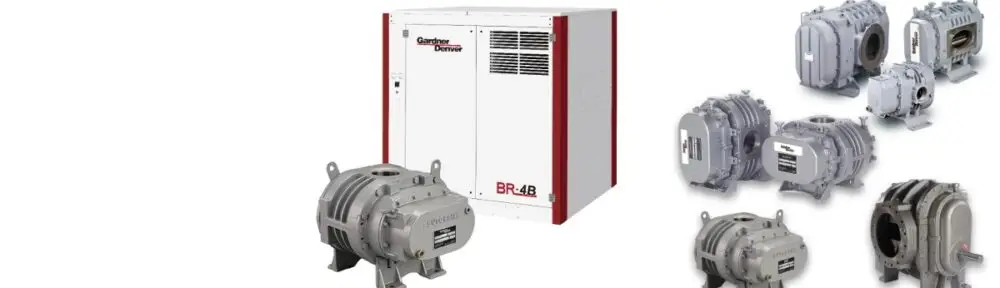
Lewis Systems offers several Gardner Denver technologies, including: 

  • CycloBlower for applications where energy efficiency, continuous operation, higher pressure or vacuum capability, and reduced pulsation are priorities  
  • HeliFlow for applications where lower noise, reduced pulsation, and reliability are important  
  • TriFlow for industrial vacuum applications requiring lower noise, vibration, and pulsation with flexible installation  
  • DuroFlow for applications that prioritize durability, dependable performance, oil-free air, and mounting flexibility  
  • Sutorbilt for demanding continuous-duty applications with multiple configuration options  
  • IQ blower packages for facilities looking for an integrated package with controls, monitoring, noise reduction, and simplified installation  

The right choice comes down to what your process actually requires rather than simply choosing the blower with the highest airflow or pressure rating. 

What Applications Use Positive Displacement Blowers? 

Positive displacement blowers are used across a wide range of industrial processes. Lewis Systems supports applications including: 

  • Wastewater treatment  
  • Pneumatic conveying  
  • Dry bulk handling  
  • Chemical processing  
  • Industrial vacuum systems  
  • Power generation  
  • Food and dairy processing  
  • Environmental remediation  

Because the operating conditions can vary significantly between these applications, equipment should be selected around the specific process rather than the industry alone. 

Find the Right Blower for Your Application 

Choosing the right positive displacement blower starts with understanding what your process needs today and how the equipment will operate over time. 

Lewis Systems can evaluate your airflow, pressure or vacuum, duty cycle, energy use, noise concerns, available space, and maintenance requirements to help identify the right blower technology and configuration for your application. Lewis Systems also provides installation, preventative maintenance, troubleshooting, repairs, replacement parts, and long-term support.  

Need Help Choosing a Positive Displacement Blower? 

Talk with Lewis Systems about your application and get help selecting a blower based on your actual operating requirements. 

Find the Right Positive Displacement Blower: Explore Lewis Systems Positive Displacement Blowers 
Medical Air & Gas Solutions

What Should Be Included in a Medical Air & Vacuum Preventive Maintenance Plan? 

Medical air and vacuum systems support critical applications throughout healthcare facilities. When equipment begins to wear, monitoring issues develop, or system performance changes, waiting for a failure can create unnecessary downtime and more difficult repairs. 

A preventive maintenance plan gives your facility a more proactive approach. Instead of waiting for something to stop working, planned service helps identify developing equipment issues and maintain reliable system performance over time. 

Lewis Systems provides preventive maintenance and ongoing service for medical air and vacuum systems, including compressors, vacuum pumps, controls, monitoring equipment, and related system components.  

Why Is Preventive Maintenance Important for Medical Air and Vacuum Systems? 

Medical air and vacuum equipment need to perform reliably whenever it is needed. A problem with one component can affect the performance of the larger system. 

Regular maintenance gives technicians an opportunity to inspect equipment condition, identify signs of wear, address developing problems, and make maintenance recommendations before an issue becomes an unexpected failure. 

A planned approach can also help facilities schedule service around their operations instead of dealing with repairs only after equipment goes down. Lewis Systems specifically supports service coordination around facility operations and long-term maintenance planning.  

What Medical Air Equipment Should Be Maintained? 

The compressor is only one part of a medical air system. Reliable medical air depends on several components working together to maintain the required air quality, pressure, capacity, monitoring, and redundancy. 

Depending on your system, preventive maintenance may need to account for: 

  • Medical air compressors  
  • Air receivers  
  • Dryers  
  • Filters and air treatment components  
  • Dew point monitoring  
  • Carbon monoxide monitoring  
  • System controls  
  • Alarm capabilities  
  • Related source equipment  

Lewis Systems supports medical air systems that incorporate these components, along with preventive maintenance and repair service.  

What Should Be Checked on a Medical Vacuum System? 

Medical vacuum systems also rely on more than the vacuum pump itself. 

The equipment needs to provide dependable suction based on the facility’s demand while maintaining the redundancy and reliability required by the application. Preventive maintenance should consider the condition and operation of the vacuum equipment as well as the controls and supporting components that help the overall system perform as intended. 

Lewis Systems provides preventive maintenance, vacuum pump repair, troubleshooting, replacement parts, system evaluations, and equipment replacement planning for medical vacuum systems.  

Don’t Forget Controls, Alarms, and Monitoring 

A compressor or vacuum pump may be operating, but that doesn’t necessarily mean every part of the system is performing as expected. 

Controls, alarms, and monitoring equipment provide important information about system conditions. Including these components in your maintenance approach can help identify issues that might otherwise go unnoticed. 

Lewis Systems’ medical system capabilities include integrated controls and alarms as well as dew point, carbon monoxide, and system monitoring for medical air applications.  

What About Medical Gas Pipeline Components? 

The source equipment is only one part of a complete medical air, vacuum, and gas system. Pipeline components are responsible for distributing and monitoring medical gases and vacuum throughout the facility. 

Lewis Systems supports pipeline equipment including outlets, alarms, zone valves, manifolds, regulators, controls, and replacement components. When planning long-term system maintenance, facilities should consider how source equipment, pipeline components, controls, and monitoring work together rather than treating each as an unrelated piece of equipment.  

How Often Should Medical Air and Vacuum Equipment Be Serviced? 

There isn’t one maintenance schedule that applies to every piece of equipment or every facility. 

Maintenance needs can depend on the equipment manufacturer, system configuration, operating hours, equipment condition, and facility requirements. Rather than relying on a one-size-fits-all schedule, facilities should build preventive maintenance around their specific equipment and operating needs. 

Lewis Systems offers customized service agreements and preventive maintenance support to help facilities develop a more planned approach to maintaining compressed air and vacuum equipment.  

Build a Maintenance Plan Around the Complete System 

A strong medical air and vacuum preventive maintenance plan should go beyond reacting to individual equipment problems. 

Lewis Systems looks at how medical air compressors, vacuum pumps, air treatment, controls, monitoring, pipeline components, and service requirements work together. This complete-system approach can help facilities identify developing issues, plan maintenance, address recurring reliability concerns, and make better decisions about future repairs or equipment replacement.  

Keep Your Medical Air & Vacuum Systems Ready 

Don’t wait for an unexpected equipment problem to determine what needs attention. Lewis Systems provides preventive maintenance, troubleshooting, repair, parts, and long-term support for medical air and vacuum systems. 

Schedule Medical Air & Vacuum Maintenance: Explore Lewis Systems Medical Air & Gas Solutions

Can I Use My Existing Air Compressor for an On-Site Nitrogen Generator? 

If you’re considering an on-site nitrogen generator, you may already have an air compressor supplying your facility. So, do you need another compressor, or can you use the one you already have? 

Possibly. Your existing air compressor may be able to support an on-site nitrogen generator, but having compressed air available doesn’t automatically mean your system is ready for nitrogen generation. 

Your compressor needs enough available capacity, the right operating pressure, and properly treated compressed air to support both the nitrogen generator and the rest of your facility’s demand. 

Why Does a Nitrogen Generator Need Compressed Air? 

An on-site nitrogen generator starts with compressed air. 

Your air compressor draws in ambient air, which contains nitrogen, oxygen, and other gases. Before entering the nitrogen generator, that compressed air is filtered and dried. The generator then separates nitrogen from the other gases and supplies it to your process at the required purity, pressure, and flow. 

That means the performance of your nitrogen generator is directly connected to the compressed air system feeding it. 

Before adding a generator, you need to know whether that system can handle the additional demand. 

Does Your Air Compressor Have Enough Capacity? 

This is one of the first things to evaluate. 

Your existing compressor may already be supplying production equipment, pneumatic tools, controls, or other processes throughout your facility. Adding a nitrogen generator creates additional demand on that same compressed air system. 

If there isn’t enough available capacity, adding another demand could affect your ability to maintain the pressure and airflow required elsewhere in the facility. 

That’s why looking only at the compressor’s rated capacity isn’t enough. You also need to understand how much air your facility is currently using and how much capacity is actually available. 

Lewis Systems can assess your existing compressed air system and nitrogen demand to determine whether your compressor can support both. 

Is Your Compressed Air at the Right Pressure? 

Capacity isn’t the only consideration. The nitrogen generator also needs compressed air supplied at the appropriate pressure. 

If your existing system can’t maintain the pressure required by the generator while also supporting the rest of your facility, nitrogen production may not perform as intended. 

Nitrogen flow and purity requirements can also affect how the overall system needs to be configured. Looking at these requirements together helps determine whether your existing compressed air system is a good fit. 

Is Your Compressed Air Properly Treated? 

Before compressed air enters the nitrogen generator, it needs to be properly filtered and dried. 

That makes your existing air treatment equipment another important part of the evaluation. 

Your system may need to be reviewed for: 

  • Dryer performance  
  • Filtration  
  • Compressed air quality  
  • Moisture and contaminants  
  • Required pressure  
  • Air treatment capacity  

If your existing dryer or filtration isn’t appropriate for the nitrogen generation system, additional air treatment may be needed. 

How Much Nitrogen and What Purity Do You Need? 

The compressor requirements can’t be determined without understanding what you expect the nitrogen generator to produce. 

A facility that needs a relatively small amount of nitrogen has different requirements than one with high or continuous demand. The purity required by your process matters too. 

Lewis Systems offers both PSA and membrane nitrogen generation systems. The right technology depends on your process, available compressed air, operating schedule, purity requirements, and other system needs. 

The goal is to size the system around what your process actually needs rather than producing more nitrogen or higher purity than necessary. 

What Should Be Evaluated Before Adding a Nitrogen Generator? 

Before deciding whether your existing compressor can support on-site nitrogen generation, look at the system as a whole: 

  • Available compressor capacity  
  • Current facility air demand  
  • Required operating pressure  
  • Compressed air quality and treatment  
  • Required nitrogen flow  
  • Required nitrogen purity  
  • Operating schedule  
  • Storage and piping requirements  

Evaluating these factors together helps determine whether your current compressor is ready to support nitrogen generation or whether changes to the compressed air system should be made first. 

Make Sure Your Existing System Is Ready 

You may not need a new air compressor to add an on-site nitrogen generator, but it’s important to find out before investing in the equipment. 

Lewis Systems can evaluate your existing compressor, air treatment, storage, piping, and process demand to determine what your complete nitrogen generation system requires. 

That helps ensure your nitrogen generator isn’t simply connected to an available air line. It’s supported by a compressed air system capable of meeting the needs of your operation. 

Is Your Compressor Ready for On-Site Nitrogen Generation? 

Lewis Systems can evaluate your existing compressed air system and nitrogen requirements to help determine what you need to produce nitrogen reliably on-site. 

CTA: Evaluate Your Nitrogen Generation Needs 

Lewis Systems On-Site Nitrogen Generators